Live fleet
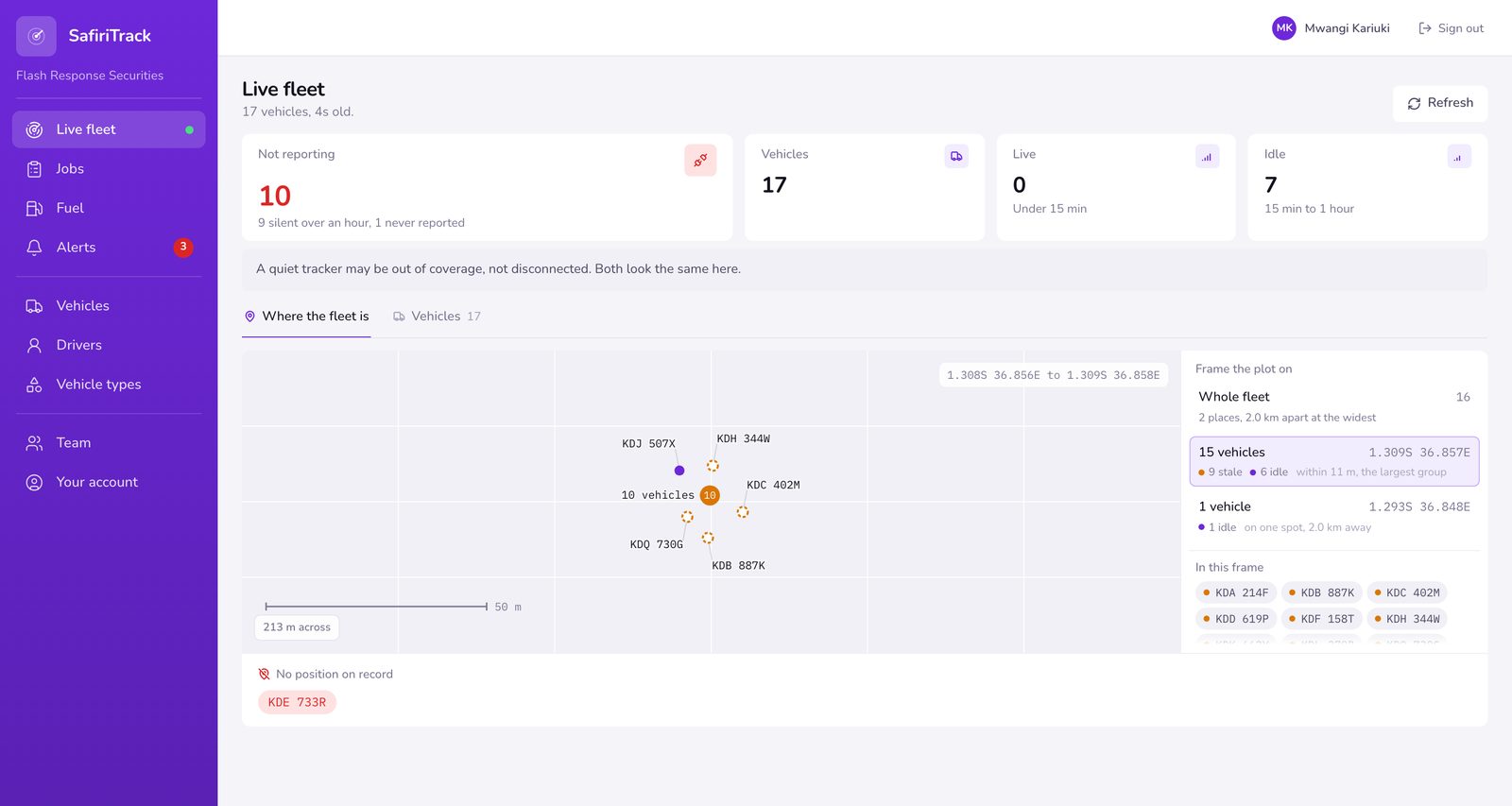
Every vehicle on one screen with its reporting state: live, idle, stale, or never heard from. A quiet tracker is a finding, not a blank cell.
▪ Fuel & location telematics
A tracker on its own answers “where is the van?”. SafiriTrack pairs it with a sensor in the tank, so every litre you paid for is measured against every litre the tank saw and every kilometre driven. Every drop carries a confidence score, so a reading about a vehicle never turns into an accusation about a person.
Runs on its own, or inside SafiriOS through its API. Teltonika trackers, calibrated tank probes, sourced and fitted in Nairobi.
Live fleet
Every vehicle, and every tracker gone quiet
▪ The problem
The receipt says 60. The tank saw 48. Nobody can say where the other twelve went, so the argument starts.
The one thing a tracker alone cannot see: fuel leaving a tank while the engine is off and the vehicle is in the yard.
Booked for 06:00, set off at 06:31, on a different vehicle. Without the record it is one person's word against another's.
A drop while parked with the ignition off is the signal. A drop while moving is usually slosh.
▪ 01 · Live fleet
Where each vehicle is, how long since it last spoke, what it is doing and how much is in the tank, on one screen. Trackers that have gone quiet lead the list, because a disconnected tracker may be a disabled tracker.
▪ 02 · Fuel, accounted
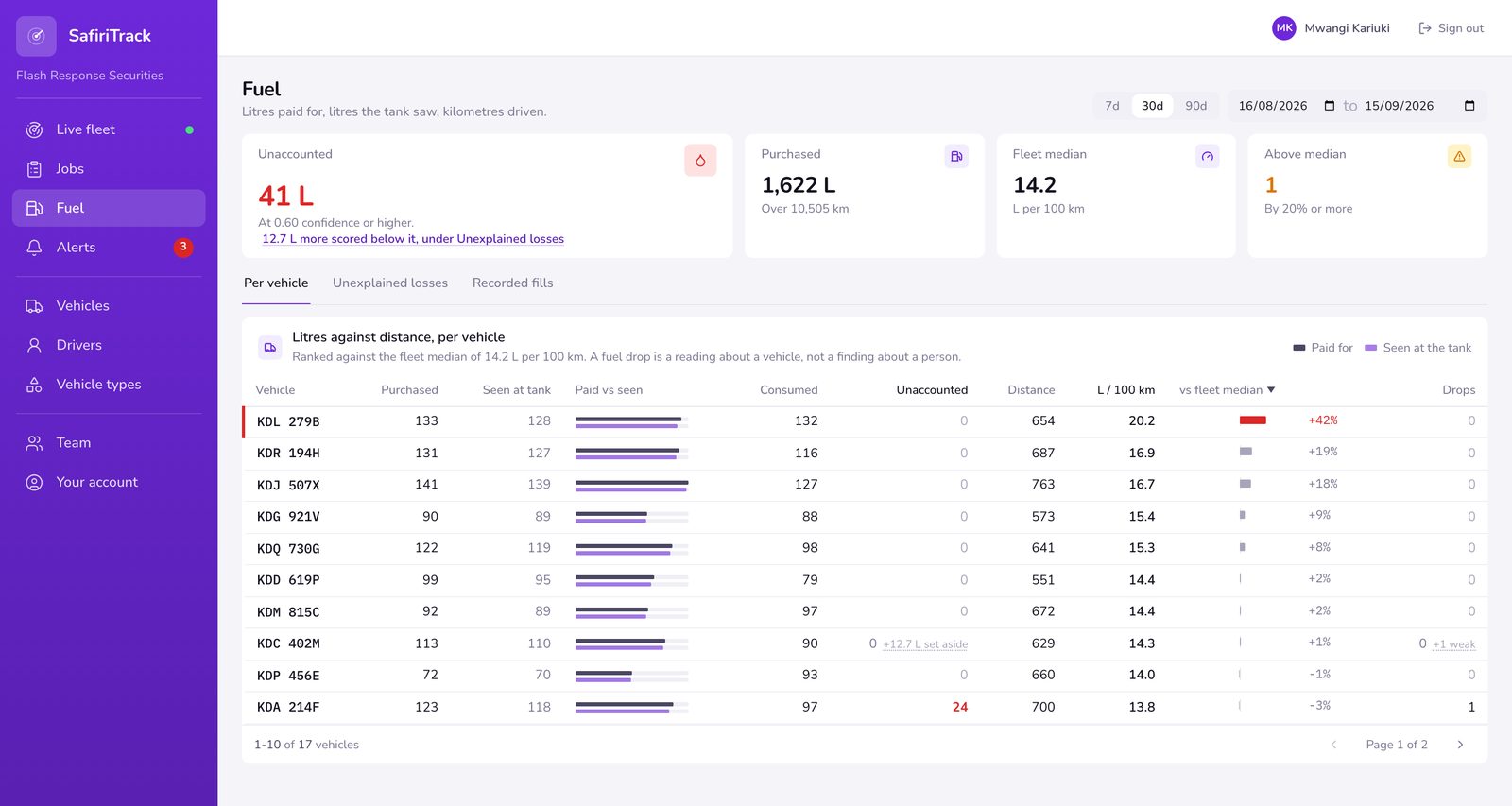
Per vehicle, per window: the litres a person recorded at the pump, the litres the probe saw arrive, the litres consumed and the kilometres driven, ranked against the fleet median. What cannot be explained by the road is the unaccounted figure, and only drops scored above the confidence floor count towards it.
▪ 03 · Jobs against reality
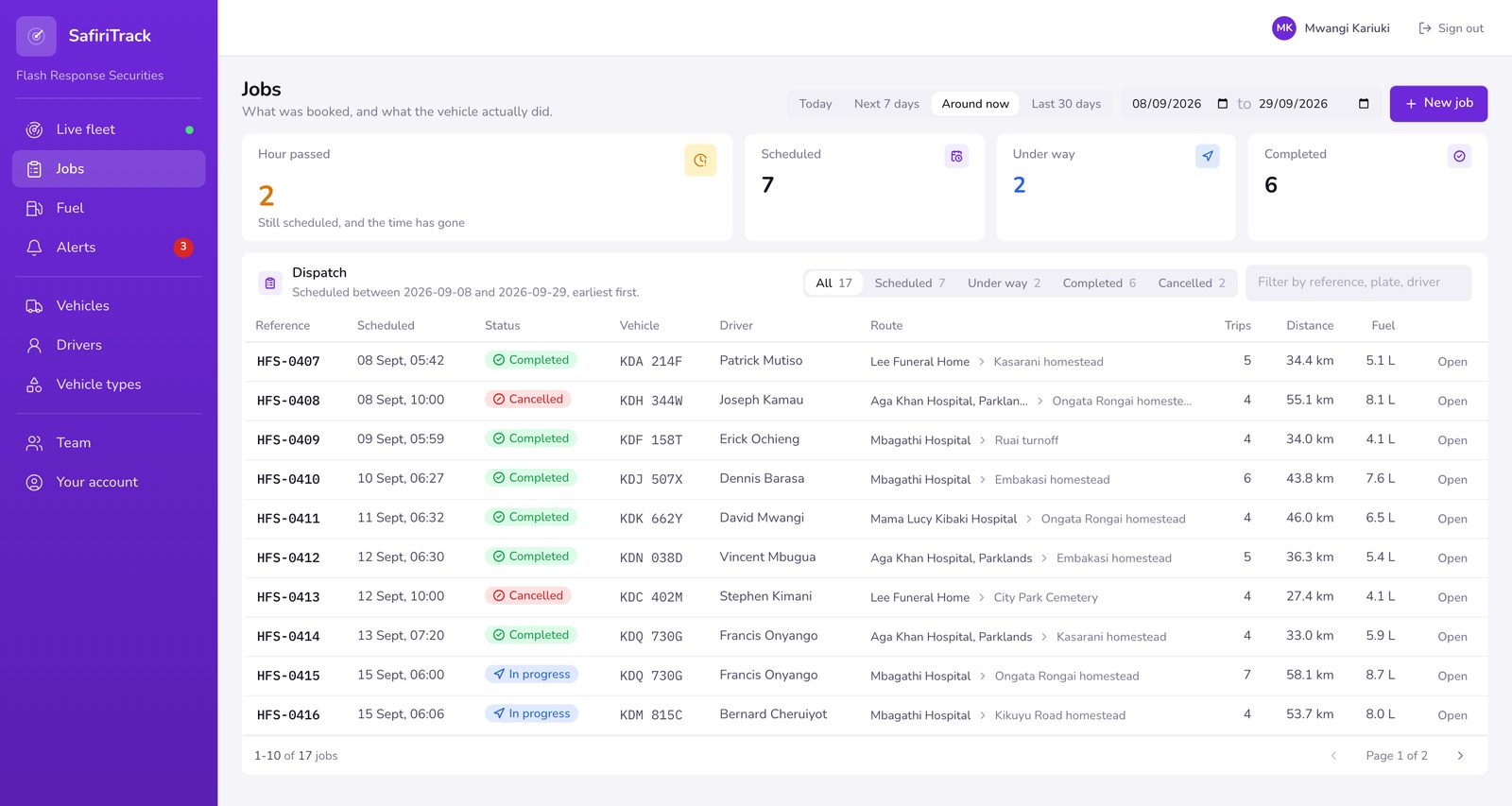
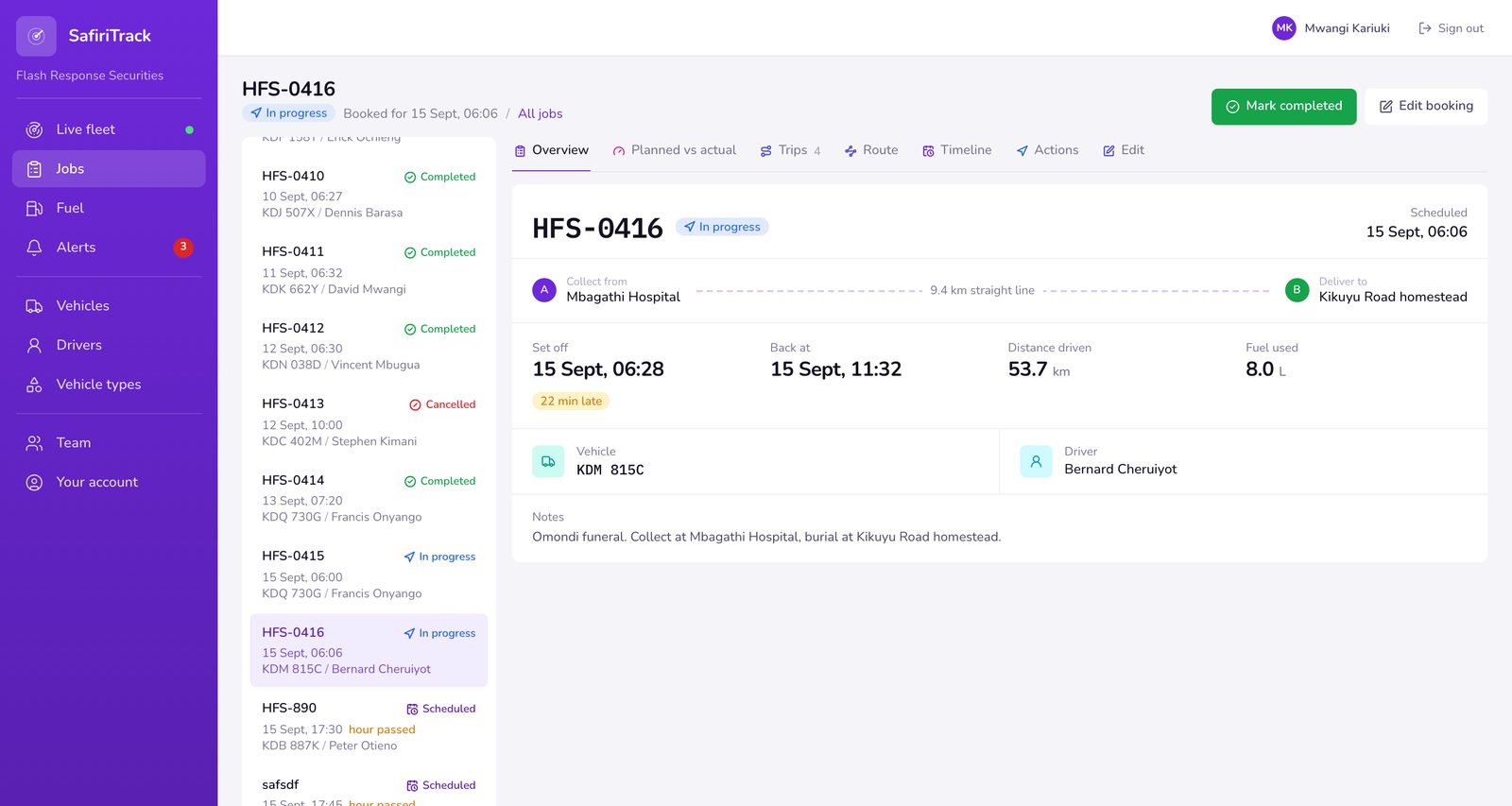
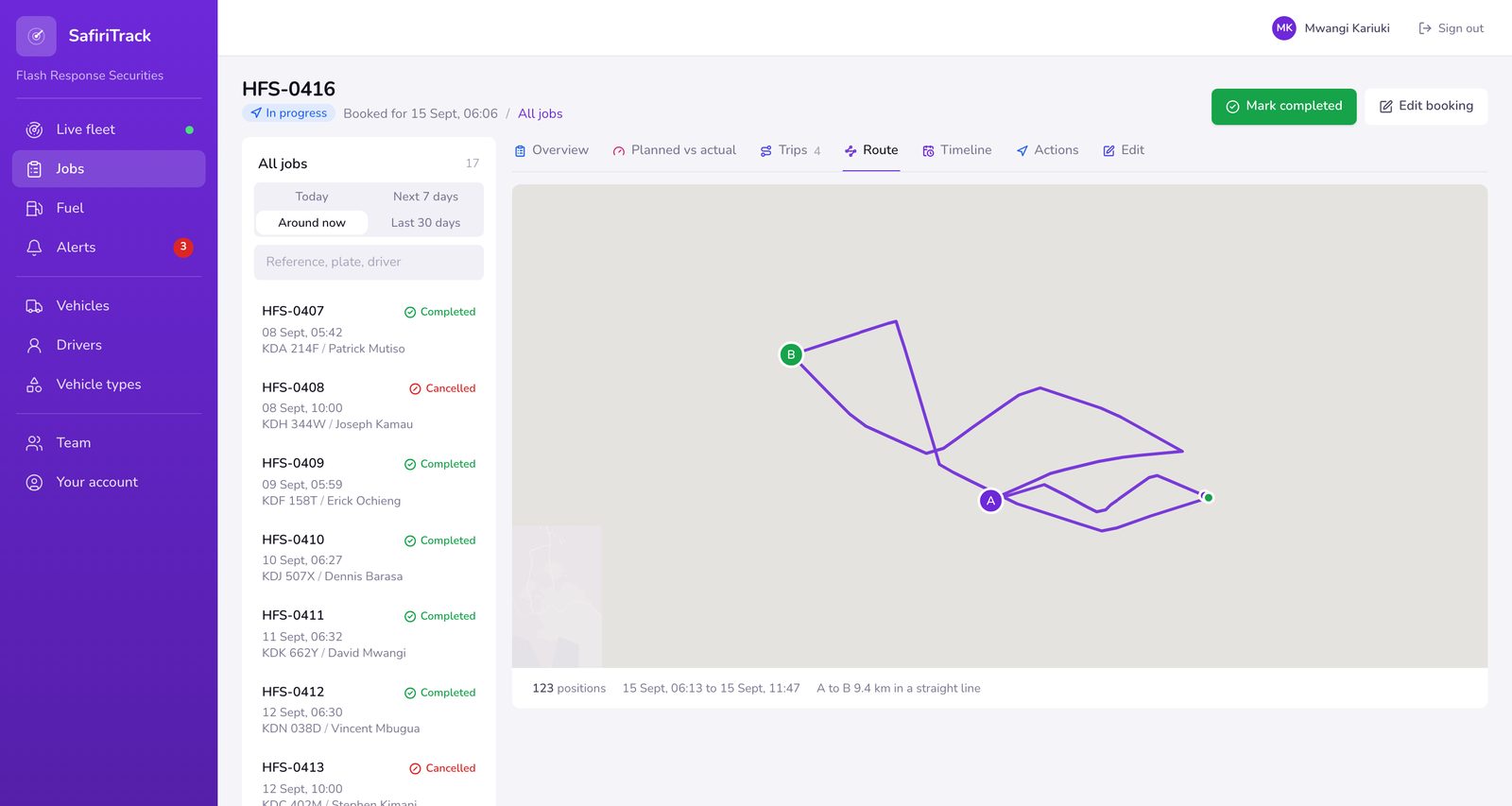
Every job carries the trips the tracker matched to it: set off at 06:31 against a 06:00 booking, the vehicle that actually drove, the kilometres and litres it took. The difference is shown, not argued.
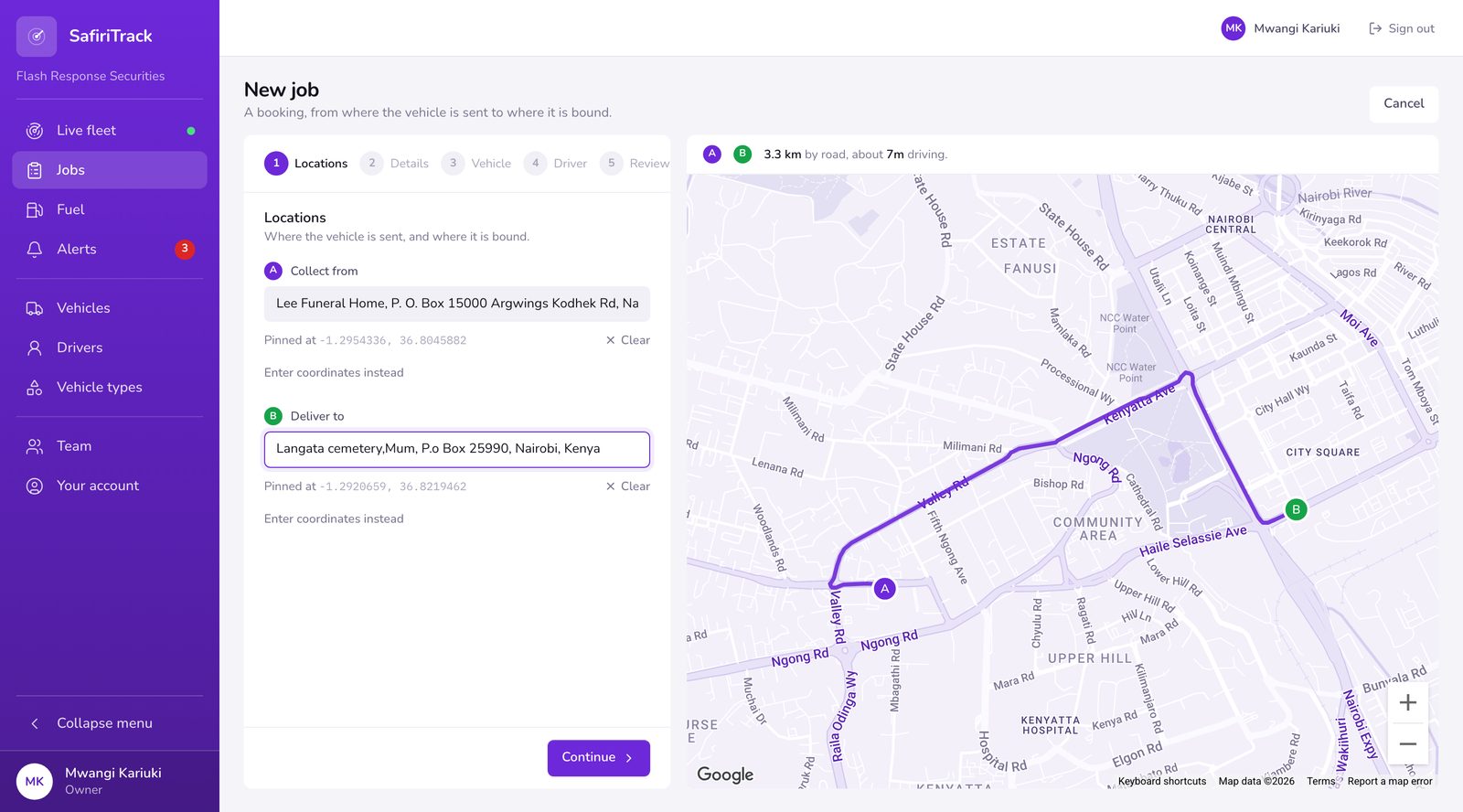
▪ 04 · A booking, A to B
Collection point and destination from a place search, the road route and its distance, then the vehicle and the driver from the fleet, in four steps. Afterwards, the route the tracker actually recorded sits on the same map.
▪ What you get
Every vehicle on one screen with its reporting state: live, idle, stale, or never heard from. A quiet tracker is a finding, not a blank cell.
Litres paid for, litres the tank saw arrive, litres consumed and kilometres driven, per vehicle, ranked against the fleet median.
A drop is only counted when the vehicle was parked and the reading had settled. Each carries a confidence from 0 to 1; weak ones are set aside, not hidden.
The booking on one side, the trips the GPS actually recorded on the other, with the delta in the middle: late, wrong vehicle, more fuel than the road explains.
A to B with a road route, distance and drive time, and the vehicle and driver picked from the fleet in four steps.
A reading is about a vehicle. The product says so on every screen, because a false accusation costs more than the fuel.
▪ How it works
01
A Teltonika tracker wired to the battery and ignition, and a capacitive probe in the tank. Two to three hours per vehicle, by an installer who has drilled fuel tanks before.
02
Fuel goes in in known steps, at least eight, and the probe's reading is recorded at each. That table is what turns a height into litres for that tank's shape.
03
Two weeks of readings before anyone is spoken to. The first thing the data shows is usually the pump, the paperwork, or a rod cut short, not a person.
▪ Hardware
FMC125 and FMC130 (4G, 2G fallback). Codec 8E is read out of the box, so fuel level arrives as a standard field.
Escort TD-BLE (wireless) and TD-150 (wired), accurate to about 1% of the tank, sold and fitted in Nairobi.
Safaricom or Airtel, a small data bundle per vehicle. The tracker stores readings when out of coverage and sends them when it returns.
Runs on its own with its own logins, or feeds fuel and distance into SafiriOS through its API.
Budget from about KES 30,000 per vehicle fitted and calibrated, then a small data bundle a month. No subscription to anyone else's platform.
▪ Get started
Local stock, fitted and calibrated, reporting into your own screens within days. Then the rest of the fleet once the first two weeks have shown what they show.